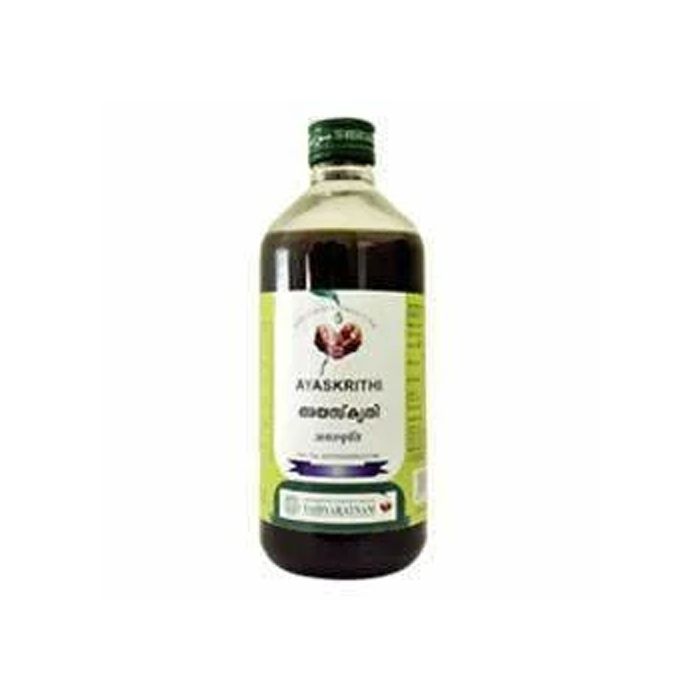
Ayaskriti from Vaidyaratnam Oushadhasala is a classical herbo-mineral fermentation built on a long decoction of heartwoods and barks. It is taken to support healthy sugar metabolism, clear skin and easy regularity. It carries naturally occurring alcohol from its own fermentation, and jaggery and honey form its base.
Ayaskriti from Vaidyaratnam Oushadhasala is a classical herbo-mineral fermented tonic, taken after food to support healthy sugar metabolism, steady weight and clear, even skin.
Ayas is the classical Sanskrit name of the mineral constituent the whole preparation is built around, and kriti means a making or a thing prepared, so the name marks this out as the classical preparation in which that constituent is carried by a fermented decoction.
Ayurvedic Significance
Classical practice reads unsteady sugar metabolism as Prameha, a disturbance of Kapha over an overloaded Meda dhatu, with the Medovaha srotas grown sluggish. Ayaskriti answers that with an unusually long decoction of dense heartwoods and barks, all of them ruksha and kashaya, drying and astringent where there is heaviness and damp. The self generated alcohol carries those tannin rich constituents far better than water could, which is why the fermented form was chosen.
Traditional Uses & Benefits
Healthy sugar metabolism: The first of the classical indications, approached by drying and lightening Kapha and Meda dhatu.
Healthy weight management: The astringent heartwood group is the classical answer to accumulation, taken as a long course.
Clear, even skin: Khadira with Daruharidra and the sandalwoods is the classical pairing where skin tone has grown uneven.
Comfortable regularity: Named in the classical indications and supported by the astringent, toning direction of the whole.
A balanced gut environment: Vidanga and Kutaja carry the classical Krimi related use.
Healthy blood: The formulation is traditionally taken where Rakta dhatu needs building alongside everything else.
Traditional uses as set out in classical Ayurveda; these are not statements of medical effect.
Key Ingredients
Decoction of
Khadira (Acacia catechu) and Kadara (Acacia suma): Two catechu heartwoods, the most astringent constituents of the group and the classical support for clear skin.
Asana (Pterocarpus marsupium): Indian kino heartwood, the wood classical practice names first where sugar metabolism has grown unsteady.
Meshasringi (Gymnema sylvestre): The leaf traditionally chewed to dull the taste of sweetness, long associated with Prameha.
Arjuna (Terminalia arjuna) and Dhava (Anogeissus latifolia): Two astringent barks that tone the tissues.
Chandana and Rakthachandana: White and red sandalwood heartwoods, cooling and steadying against a drying formulation.
Daruharidra (Berberis aristata): Bitter stem bark, classically paired with the catechus for the skin.
Simshapa, Tinisa, Saka, Sala, Agaru, Chagakarna and Aswakarna: The dense heartwoods that give the decoction its weight and long simmer.
Bhurja, Sireesha, Palasa, Puga, Tala, Karanja and Poothi Karanja: The supporting barks, seeds and flowers that complete the classical group.
Powder of
Kutaja (Holarrhena antidysenterica) and Vidanga (Embelia ribes): The classical pair for a balanced gut environment.
Katuka (Picrorhiza kurroa) and Bharangi (Clerodendrum serratum): Two bitters that keep the formulation from turning heavy.
Trikatu group and Chavya (Maricha, Pippali, Pippalimoola, Sunti, Chavya): The pungent constituents that hold Agni steady.
Ela, Ajaji, Jeeraka, Ajamoda and Sarshapa: The aromatic seeds that round a very astringent base.
Murva, Pata, Katvanga and Pasugandha, with Hingu and Chithraka taken through classical Shodhana: The remaining classical supports.
Mineral Constituent
This is a herbo-mineral preparation. Alongside the herbs it carries Lohapatra, prepared by the classical Shodhana process and named here in its traditional Sanskrit form.
Base & Others
Guda: Jaggery, the sweet base and the substrate the fermentation feeds on.
Madhu: Honey, added in the classical manner.
Ghrutha: Ghee, present as required by the classical method.
Laksha: Lac, the traditional finishing constituent.
Suggested Use
15 to 30 ml twice daily after food, diluted with an equal quantity of warm water as Anupana. Taking it after meals is part of the classical instruction for a fermented preparation. Use under the guidance of a qualified Ayurvedic practitioner.
Safety & Certifications
GMP certified production: Prepared by Vaidyaratnam Oushadhasala in a GMP certified facility under documented quality controls.
Prepared per classical texts: Made by the traditional method, a long heartwood decoction left to ferment on its own with jaggery over several weeks.
Contains naturally occurring alcohol: This preparation generates its own alcohol during fermentation, and that alcohol is part of how it works, carrying the tannin rich constituents that water alone would leave behind. Anyone avoiding alcohol for any reason should take qualified Ayurvedic practitioner guidance before choosing this form, and a practitioner can suggest a non fermented preparation instead.
Contains jaggery and honey: Jaggery is the sweet base and the fermentation substrate, and honey is added in the classical manner, so the finished tonic carries natural sugars. This matters particularly here, since the formulation is chosen by people watching sugar intake. Count the serving in and take practitioner guidance first.
Contains ghee: Ghee is part of the classical method, so this does not suit a dairy free or vegan routine.
Herbo-mineral formulation: It carries the classical mineral constituent Lohapatra alongside a small number of potent botanicals, each taken through traditional Shodhana. It is selected with qualified Ayurvedic practitioner guidance rather than chosen unsupervised.
Pregnancy and nursing: Not selected during pregnancy or while nursing except under the direct guidance of a qualified Ayurvedic practitioner.
Storage: Store in a cool, dry place away from direct sunlight with the cap closed. A little natural sediment is normal; shake gently before pouring.
Ayaskriti is a classical herbo-mineral fermented preparation. Classical practice uses it to support:
Healthy sugar metabolism, read in the texts as Prameha, a Kapha disturbance over an overloaded Meda dhatu
Healthy weight management and lightness
Clear, even skin and comfortable regularity
A balanced gut environment, the classical Krimi related use
Traditional uses as set out in classical Ayurveda; these are not statements of medical effect. It is supportive traditional care taken alongside, not in place of, the care of a qualified health professional.
+What is in Ayaskriti?
An unusually long decoction of dense heartwoods and barks, a group of fine powders, and one classical mineral constituent, all fermented together in jaggery.
Heartwoods and barks: Khadira, Kadara, Asana, Simshapa, Tinisa, Arjuna, Dhava, Chandana, Rakthachandana, Daruharidra, Agaru, Saka, Sala, Chagakarna, Aswakarna, Bhurja, Sireesha and others
Meshasringi (Gymnema sylvestre), long associated with Prameha
Powders: Kutaja, Vidanga, Katuka, Murva, Bharangi, Pata, the Trikatu group, Chavya and the aromatic seeds
Lohapatra, the classical mineral constituent, taken through traditional Shodhana and named here in its Sanskrit form
Guda (jaggery), Madhu (honey), Ghrutha and Laksha in the base
+Why is Ayaskriti built on heartwoods rather than soft herbs?
Because the classical reading calls for drying and lightening. Prameha is understood as Kapha over an overloaded Meda dhatu, with the Medovaha srotas grown sluggish, and the dense heartwoods are all ruksha and kashaya, drying and astringent, which is exactly the counterweight to heaviness and damp. Their tannin rich constituents also need the self generated alcohol to be carried properly, which is why the fermented form was chosen over a simple decoction.
+How do you take Ayaskriti?
15 to 30 ml twice daily after food, diluted with an equal quantity of warm water as Anupana. A few pointers:
Diluting is traditional and sits more comfortably.
Taking it after meals is part of the classical instruction for a fermented preparation.
Shake the bottle gently before pouring, since natural sediment settles.
Use it steadily alongside a settled diet and daily routine.
The bottle holds 450 ml. A qualified Ayurvedic practitioner can tailor the amount to you.
+Can Ayaskriti replace care I am already receiving?
No. Ayaskriti is supportive traditional care and sits alongside, never in place of, care you are already receiving from a qualified health professional, including any diet, activity or ongoing course they have set out. If sugar metabolism is being monitored, keep to that monitoring and speak with both that professional and a qualified Ayurvedic practitioner before adding this or any other preparation. Note in particular that the fermented base carries natural sugars.
+Which dosha does Ayaskriti balance?
Chiefly Kapha, the dosha Ayurveda links to heaviness, damp and a sluggish Meda dhatu. The astringent heartwoods dry and lighten, while the Trikatu group and purified Chithraka keep Agni steady, which also helps a Vata weakened digestion. The formulation is drying overall, so those of a markedly Pitta constitution, or anyone who finds sharp preparations unsettling, should take it with practitioner guidance.
+Does Ayaskriti contain alcohol, and what is the mineral constituent?
Yes to the alcohol. As a classical fermented preparation it carries naturally occurring alcohol generated during its own fermentation. None is added, and it is part of how the preparation works, carrying the tannin rich heartwood constituents that water alone would leave behind. Anyone avoiding alcohol for any reason should take qualified Ayurvedic practitioner guidance first, and a practitioner can point to a non fermented preparation instead.
On the mineral: the name Ayas refers to the classical constituent Lohapatra, which is a genuine ingredient of the formula rather than only a vessel it is prepared in. It is taken through traditional Shodhana before it enters the preparation, which makes this a herbo-mineral formulation, selected with practitioner guidance.
+Does Ayaskriti contain sugar?
Yes, and it is worth being clear about it. Jaggery (Guda) is both the sweet base and the substrate the fermentation feeds on, and honey (Madhu) is added in the classical manner, so the finished tonic carries natural sugars. That matters particularly with this formulation, because it is often chosen by people who are watching their sugar intake. Count the serving in, keep to any monitoring you already do, and take guidance from a qualified Ayurvedic practitioner before starting. Because honey is present, it is not suitable for infants under twelve months.
+What should I know before choosing Ayaskriti?
A few points are worth knowing:
It carries naturally occurring alcohol from its own fermentation, so anyone avoiding alcohol should take practitioner guidance and can be pointed to a non fermented preparation instead.
Jaggery and honey are both structural to it, so every serving carries natural sugars. Count them in, especially if sugar intake is the reason you are considering it.
Ghee is part of the classical method, so it does not suit a dairy free or vegan routine.
It is a herbo-mineral formulation carrying Lohapatra and a small number of potent botanicals, each taken through traditional Shodhana. Select it with qualified Ayurvedic practitioner guidance rather than unsupervised.
During pregnancy, while nursing, or alongside any ongoing course of care, take practitioner guidance first.
While we work to ensure that product information is correct, on occasion manufacturers may alter their ingredient lists. Actual product packaging and materials may contain more and/or different information than that shown on our Web site. We recommend that you do not solely rely on the information presented and that you always read labels, warnings, and directions before using or consuming a product. For additional information about a product, please contact the manufacturer. Content on this site is for reference purposes and is not intended to substitute for advice given by a physician, pharmacist, or other licensed health-care professional. You should not use this information as self-diagnosis or for treating a health problem or disease. Contact your health-care provider immediately if you suspect that you have a medical problem. Information and statements regarding dietary supplements have not been evaluated by the Food and Drug Administration and are not intended to diagnose, treat, cure, or prevent any disease or health condition. AyurvedaBay.com assumes no liability for inaccuracies or misstatements about products.