
Dhanvantaram Tailam (200ml) | Ayurvedic Oil for Muscle, Joint & Nerve Wellness
- 2 or more : $9.97
- 5 or more : $9.44
- 10 or more : $8.92
- 20 or more : $8.39
Dhanvantaram Tailam is the most widely used general massage oil in Kerala Ayurveda, suited to all constitutions and especially Vata and Pitta. It carries the name of Dhanvantari, the divine physician and patron deity of Ayurveda; taila means oil. Applied in abhyanga, it nourishes mamsa and majja dhatu while settling Vata.
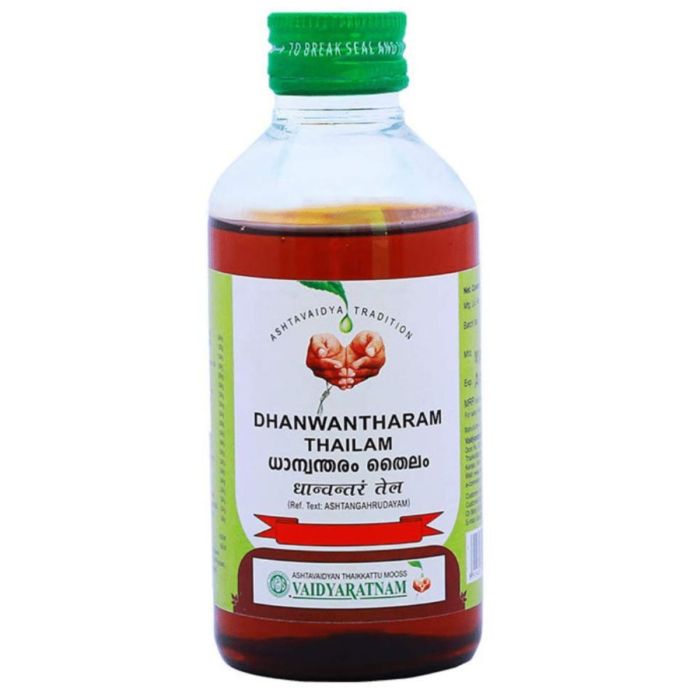
| SKU | Health Concern | Pack Size | Main Ingredient | Specialty | Brand |
|---|---|---|---|---|---|
| 3289 | Joint & Muscle Support | 200 ml | Bala | Traditional Ayurvedic Formula | Vaidyaratnam Oushadhasala |
Dhanvantaram Tailam from Vaidyaratnam Oushadhasala is the most widely used general massage oil in Kerala Ayurveda, a fragrant, earthy preparation suited to all constitutions and particularly to Vata and Pitta. It carries the name of Dhanvantari, the divine physician who rose from the churning of the cosmic ocean bearing the pot of amrita, and who is honoured as the patron deity of Ayurveda. Taila means oil. Built on a sesame base processed with milk, the formulation gathers Bala, Ashwagandha, Shatavari, sandalwood and Manjishtha into an oil that nourishes muscle, joint and nerve alike.
Ayurvedic Significance
The classical taila paka vidhi underpins its action. Herbs are processed into the oil base over slow heat, together with a herbal decoction and milk, the cycle repeated until the water has entirely evaporated and only the herb-saturated oil remains. Sesame is chosen as the base for good reason: the texts name it the foremost vatahara substance, warm and unctuous, with a sukshma quality that carries it into the finest channels. Its qualities directly oppose Vata's dryness, lightness and cold. Ayurveda counts abhyanga among the practices of dinacharya, the daily routine.
Traditional Uses & Benefits
- The classical general massage oil: Suited to all constitutions and especially Vata and Pitta, this is the oil Kerala practice turns to first for daily abhyanga.
- Nourishes muscle, joint and nerve together: Bala with Ashwagandha and the sweet roots addresses mamsa and majja dhatu at once, which is why the oil is valued across neuromuscular and joint concerns rather than for one alone.
- Settles aggravated Vata: The warm, unctuous sesame base directly opposes Vata's dry, cold, mobile qualities, making this a traditional choice for longstanding Vata conditions.
- Traditional pre- and postnatal support: Kerala practice has long used this oil through pregnancy and the postnatal period, when Vata is naturally aggravated and gentle nourishment is called for.
- Suited to shirodhara and head massage: Its cooling herbs and fine, penetrating base make it a classical choice for shirodhara and for the head, where a purely heating oil would not serve.
Key Ingredients
- Bala (Sida cordifolia): The lead herb, whose name means strength; sweet, cooling and balya.
- Ashwagandha (Withania somnifera): A premier rasayana, warm and grounding, building mamsa and majja.
- Shatavari (Asparagus racemosus) and Ksheervidarikanda (Ipomoea digitata): Sweet, cooling brimhana roots nourishing depleted tissue.
- Shweta Chandana (Santalum album): White sandalwood, the classical Pitta-pacifier that lets this oil suit hot constitutions.
- Manjistha (Rubia cordifolia) and Anantamoola (Hemidesmus indicus): Classical rakta-prasadana herbs, valued for clear, comfortable skin.
- Tagara (Valeriana wallichii): Grounding and fragrant, traditionally used to settle prana vayu.
- Ksheera (milk) and sesame oil: The classical base; sesame is the foremost vatahara oil.
Formulated according to the traditional principles of Ayurveda, in a base of sesame oil processed with milk.
Suggested Use
For external use only. Warm the oil gently and apply over the body, massaging with long strokes along the limbs and circular strokes over the joints, in the manner of classical abhyanga. Ayurveda advises leaving the oil on for thirty to forty-five minutes before a warm bath. Early morning is the traditional time, and the oil may be used daily over long periods. The quantity and frequency should be determined by a qualified Ayurvedic practitioner.
Safety & Certifications
- Authentic classical preparation: Manufactured by Vaidyaratnam Oushadhasala following the classical taila paka vidhi, in which the herbal decoction, milk and paste are processed into the sesame base over slow heat until only the herb-saturated oil remains.
- Quality standards: Produced in a GMP-certified facility under strict quality controls, using authentically sourced herbs.
- External use only: Not to be taken internally. Keep away from the eyes and from broken skin.
- Professional guidance: Best used with the support of a qualified Ayurvedic practitioner during pregnancy and the postnatal period, when technique and timing are traditionally set individually. Ayurveda advises against abhyanga during acute fever, indigestion or immediately after meals.
- Storage: Store in a cool, dry place away from direct sunlight, with the cap tightly closed. Thickening in cool weather is natural in a milk-processed oil; warm the bottle gently before use. The characteristic earthy aroma is a mark of authentic preparation.
Additional Information
This oil appears as Dhanvantaram Tailam, Dhanwantharam Thailam, Dhanvantharam Taila and Dhanvantari Tailam. All name the same classical preparation; the differences come from transliterating Sanskrit and Malayalam into English. You may see it labelled 41 avarthi or 101 avarthi: avarthi means a cycle of processing, the oil cooked with the herbal decoction that many times over, each round deepening its potency. This is the standard preparation, the form used for routine abhyanga.